

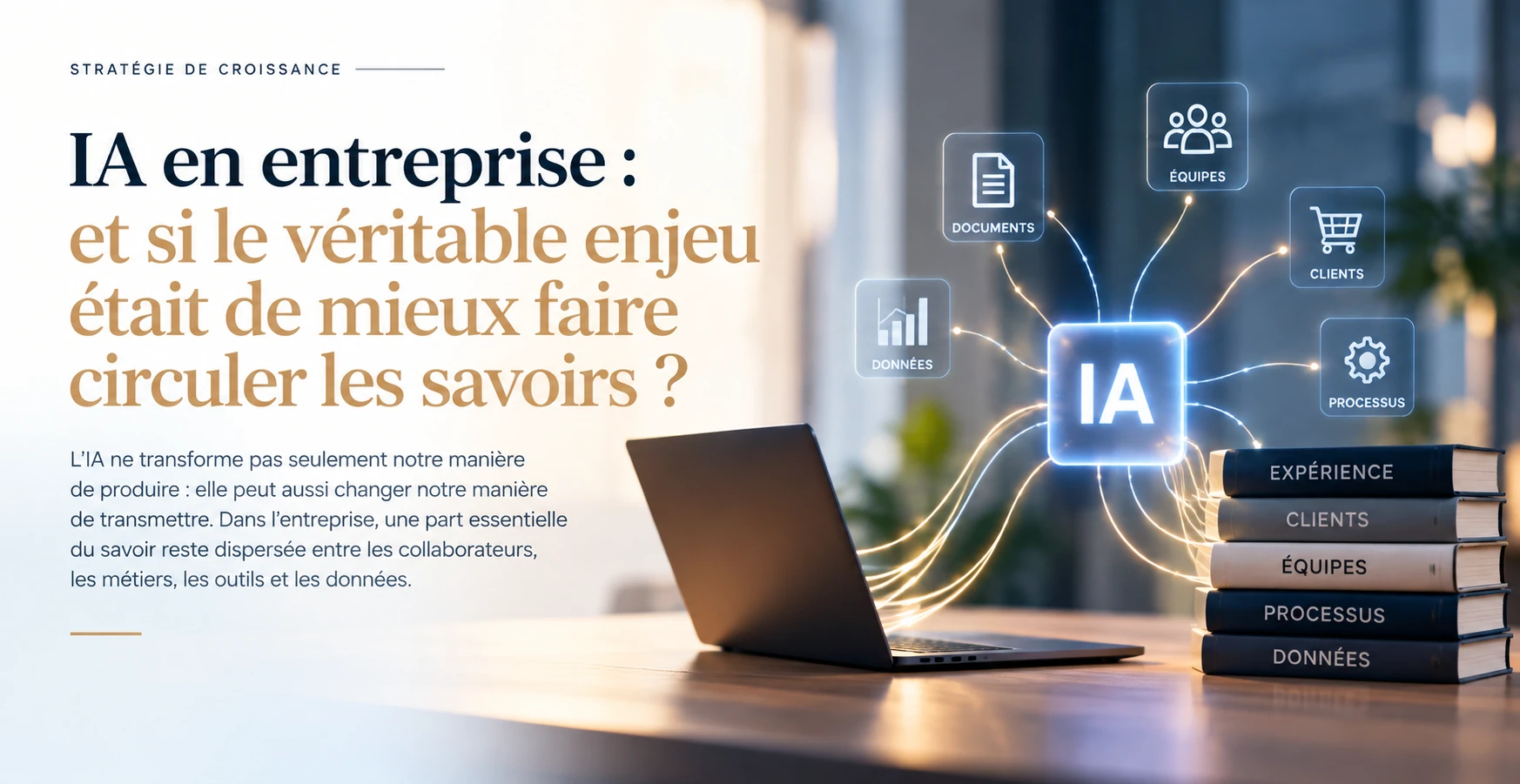
Businesses often already possess much of the intelligence they need. Yet this intelligence remains scattered across people, departments, tools and data. Rather than replacing knowledge, AI could help make it more accessible, transferable and actionable.
Perhaps we are asking the wrong question about AI
“Which jobs will artificial intelligence replace?”
Since the spectacular acceleration of generative AI, this question has become a recurring theme in businesses, the media and even conversations between colleagues. It is a legitimate question. But perhaps it has taken up so much space that it prevents us from asking another, equally strategic one.
What if the real challenge were not simply what AI is capable of learning or producing, but what it could help us to transmit more effectively?
Every business already possesses a considerable amount of knowledge. It lies within its history, its data, its tools and its processes, but above all within the experience accumulated by its people.
Yet some of this intelligence remains locked away within departments, CRMs, ERPs, emails, Excel files, meeting notes and, sometimes, simply in the minds of those who have been keeping the business running for ten, twenty or thirty years.
And perhaps this is where the real issue begins.
The problem is not always that a business does not know. The problem is that it does not always know what it knows.
The true invisible capital of a business: what its people know
In a business, the most valuable knowledge is not necessarily what appears on a dashboard.
An experienced sales adviser knows the objections customers raise repeatedly. She knows why one product performs better than another, why some customers hesitate, which arguments trigger a purchase and which promises, conversely, lead to disappointment.
Customer service teams know about friction points that dashboards do not always reveal.
The e-commerce manager knows why a commercial initiative that looked excellent on paper ultimately underperformed.
The sales director knows the history of strategic accounts, previous negotiations and sometimes the very human reasons behind certain decisions.
The logistics manager knows about operational weaknesses that no one has ever properly documented.
And an executive with thirty years of experience possesses countless instincts, warning signs and pieces of knowledge that no information system can spontaneously reproduce.
This wealth of knowledge exists. Yet some of it remains invisible.
A considerable part of a company's value appears nowhere on its balance sheet. It lies in what its people have learnt.
The risk emerges when this knowledge can no longer be transmitted, retrieved or shared.
When an experienced employee leaves the business, how many years of knowledge leave with them?
The challenge is not simply to create knowledge, but to make it flow
Businesses have never had access to so much information.
Yet having more information does not necessarily lead to better decisions.
In many organisations, marketing has its data. Sales has its own. Retail teams provide their observations. E-commerce analyses online behaviour. CRM contains part of the customer journey. Customer service discovers another part. Senior management receives consolidated dashboards.
Each team holds part of the truth.
When information remains trapped in silos
But how often does all this information actually come together?
Does a signal identified by customer service reach the e-commerce manager quickly enough?
Does an objection heard fifty times in-store ever find its way into the product page online?
Are the lessons from a campaign run twelve months ago easily accessible to the team preparing the next one?
Does feedback from sales teams genuinely influence marketing decisions?
This is where organisational silos also become knowledge silos.
The challenge is therefore no longer simply to collect information. It must be delivered to the right person, at the right time, in the right context and in a genuinely usable form.
This is precisely where artificial intelligence becomes interesting
It would be tempting to present AI as an enormous machine capable of knowing everything. That would probably be a mistake.
Its strategic value may be far more practical.
When properly integrated into an organisation, it can contribute to an essential chain.
Capture, structure, connect, retrieve, transmit and support decision-making
Capture → Structure → Connect → Retrieve → Transmit → Support decision-making
Consider a simple example.
An e-commerce manager is preparing a new commercial campaign. Traditionally, they might review previous results, consult their team, analyse Analytics data, examine CRM performance and search through various documents.
But imagine if they could also simply query the structured memory of their organisation.
- Which comparable campaigns have we run before?
- Which products achieved the highest conversion rates?
- Which objections were reported by customer service?
- What lessons were learnt from the previous campaign?
- Which CRM segments responded most strongly?
- Which logistical difficulties did we encounter?
AI does not necessarily make the decision on their behalf.
What it can do is make previously fragmented intelligence available.
The distinction is fundamental.
This is no longer simply about asking artificial intelligence to generate an answer. It is about enabling it to help an organisation reconnect its own knowledge.
The power of AI may lie not only in what it can produce, but in its ability to make what a business already knows genuinely usable.
But AI can also make mistakes circulate much faster
There is, however, a risk that would be dangerous to ignore.
Artificial intelligence does not miraculously turn a disorganised company into an intelligent organisation.
A business with inconsistent data, outdated procedures, contradictory information and poorly defined responsibilities will not solve these problems simply by adding a layer of AI.
It could even amplify them.
If inaccurate information becomes instantly accessible throughout an organisation, its potential to cause harm increases.
If two contradictory procedures coexist, AI will have to determine which one to use.
If customer data is incomplete, the conclusions drawn from it will remain fragile.
If no one knows who is responsible for the quality of information, technology will not remove that ambiguity.
Bad information augmented by AI remains bad information. It simply becomes easier to disseminate.
AI transformation begins before AI
Data quality → Organisation → Governance → Responsibilities → Processes → AI
Technology can accelerate a well-structured organisation. It cannot replace the need to structure it.
What if the real challenge of AI were also intergenerational?
There is another dimension that still receives relatively little attention: knowledge transfer between generations.
Imagine a business bringing together an employee with thirty years of industry experience, a manager with fifteen years of practice, a recent graduate completely at ease with new digital tools, and artificial intelligence capable of structuring and retrieving some of the organisation's knowledge.
Who brings the greatest value?
That is probably the wrong question.
A better question might be: “How can we make these different forms of intelligence work together?”
Turning AI into an accelerator of knowledge transfer
The experienced employee brings perspective, intuition, knowledge of exceptional circumstances and sometimes that difficult-to-explain ability to sense when an apparently rational decision is the wrong one.
The younger employee brings different practices, different instincts and new ways of accessing information and using technology.
AI can potentially create a bridge between these two worlds.
Not by replacing thirty years of experience with an algorithm, but by helping to document, structure, retrieve and transmit some of that experience.
The issue then becomes profoundly human.
AI could become less a tool for substitution and more an accelerator of knowledge transfer between generations.
And in an economy where many businesses will need to organise the transfer of expertise accumulated over several decades, this challenge could become considerable.
From a business that stores information to one that organises its intelligence
Businesses have been undergoing digital transformation for more than twenty years.
They have implemented ERPs, CRMs, Analytics solutions, e-commerce platforms, collaborative tools, cloud environments, knowledge bases, HR systems and dozens of specialist applications.
We have collected vast amounts of information.
We have stored vast amounts of information.
We have measured almost everything.
But have we connected enough of it?
This may be the next stage of digital transformation.
Turning information into decisions, and decisions into action
For a long time, the central question for information systems was: “Where is the information?”
Tomorrow, it could become: “How do we turn this information into knowledge, then turn that knowledge into decisions and action?”
The shift may seem subtle. In reality, it is considerable.
An organisation genuinely augmented by AI would not necessarily be the one using the greatest number of tools.
It would be the one that most effectively connects its data, its knowledge and the experience of its people to make better decisions.
Artificial intelligence should not erase human intelligence
The question of whether AI will replace people will legitimately continue to accompany the transformations now under way.
But it should not prevent us from exploring another path.
One in which artificial intelligence helps businesses preserve their institutional memory, break down knowledge silos, transfer experience and make collective intelligence more accessible.
From human experience to action
Human experience → Knowledge → Data & structure → Artificial intelligence → Flow → Human decision-making → Action
In this vision, people are neither at the beginning of a process designed ultimately to remove them, nor pushed to the margins of an autonomous system.
People remain at both the beginning and the end of the chain.
Experience comes from people. The final decision remains theirs.
Between the two, artificial intelligence can become a powerful accelerator for the circulation, transfer and use of knowledge.
And this may be where one of the most interesting challenges of the coming years lies.
“The real challenge of AI may not be to replace knowledge, but to make it flow more effectively throughout the organisation.”
And in your business?
What essential knowledge would disappear tomorrow if one of your key people left?