

Artificial intelligence can now respond, write, analyse, classify, recommend and automate with a level of efficiency that would have seemed improbable only a few years ago. Within businesses, it can accelerate customer service, structure e-commerce content, analyse CRM data, compare product performance and identify signals that would be difficult to detect manually.
The question is therefore no longer whether AI can perform part of the work traditionally carried out by humans. It already can — sometimes faster, sometimes with greater consistency.
The real question lies elsewhere: what happens when a business encounters a situation that has never been documented, when an intention has not yet been expressed, when a customer requires an exception, or when a business leader deliberately decides not to reproduce what historical data appears to recommend?
This is where a far more interesting boundary emerges between artificial intelligence and human expertise.
AI performs remarkably well with what a business already knows. Humans remain central when it comes to understanding what the business does not yet know and deciding what it wants to become.
Where the answer already exists, failing to automate can sometimes be a mistake
Defending the central role of humans does not mean artificially protecting every human task from automation. That would ignore one of the most important contributions of artificial intelligence in business: its ability to process considerable volumes of information rapidly, apply repetitive rules and provide an answer when the context is sufficiently well documented.
When data is accessible, a procedure exists and the expected outcome can be clearly defined, AI operates on particularly favourable ground.
Order tracking, document retrieval, request classification, CRM data summarisation, reporting, performance analysis, SEO enrichment or structured content generation: in all these situations, automation can free up a considerable amount of time and enable teams to focus their expertise where it creates greater value.
The real challenge is therefore not to restrict AI. It is to use it with sufficient precision so that we do not ask technology to assume a responsibility it cannot genuinely bear.
Customer service: AI masters the procedure, humans handle the exception
When the information exists, AI can respond immediately
Customer service illustrates this boundary particularly well.
A significant proportion of the enquiries received by a brand every day are based on information that is available and relatively stable:
- Where is my order?
- Can I return this item?
- Is this product still available in blue?
- How long do I have to make an exchange?
- How can I obtain a credit note?
- What are your delivery charges and lead times?
If artificial intelligence has reliable access to orders, stock levels, terms and conditions, commercial policies and customer service procedures, it can respond quickly and consistently.
In this context, systematically involving an employee does not necessarily improve the customer relationship. AI can instead provide an immediate response while freeing up time for situations that genuinely require listening, interpretation or judgement.
A loyal customer, a defective dress and a procedure that is no longer enough
Now imagine a customer who has been loyal to the brand for several years. She orders a dress for an important event and receives it with a defect two days before the occasion. Her size is no longer available.
The procedure states that she is entitled to a refund or a credit note.
But is that really the right response?
AI can retrieve her purchase history, check available stock, measure her purchasing frequency, summarise previous interactions and suggest several possible solutions. It can provide the team with a very rapid understanding of the case.
Yet someone still needs to assess the situation as a whole: the customer’s loyalty, her level of disappointment, the importance of the event, whether an exceptional gesture is appropriate and how the brand wishes to take responsibility for the incident.
The right answer is no longer contained solely within the procedure.
AI can prepare the response. A human still has to take responsibility for the relationship.
Creating content does not necessarily mean knowing what should be told
AI can produce a technically outstanding product page
The same reasoning applies to e-commerce content creation.
Provide an artificial intelligence system with the name of a product, its composition, cut, dimensions, colours, care instructions, functional benefits, price positioning, the keywords customers search for and the brand’s editorial guidelines.
Add an instruction requesting an HTML structure compatible with search engine optimisation: properly structured headings, semantic paragraphs, important terms highlighted appropriately and vocabulary aligned with search intent.
AI can then produce a clear, structured and coherent product page very quickly, fully SEO-compatible. It can also propose several alternatives, adjust the tone, shorten copy, enrich a sales argument or adapt a description for different channels.
It would therefore be wrong to claim that artificial intelligence cannot create. It can generate new formulations, combine ideas and suggest angles that nobody may previously have considered.
But a plausible story is not necessarily the brand’s story
Now imagine that the designer looks at that same dress and explains:
“I designed it for that particular moment at the end of a summer’s day, when you leave the beach to go out for dinner and want to remain elegant without really feeling as though you have changed.”
That intention may not have appeared anywhere in the technical specification, the PIM, the CMS or the product data.
AI could have invented an appealing story around the dress.
But it could not know that particular story until the person who created the product had expressed it.
This distinction is fundamental for brands.
AI can generate a plausible intention. Only the brand knows which intention genuinely belongs to it.
Once that intention has been expressed, however, technology can become a powerful multiplier: adapting the story for the product page, social media, a newsletter, an advertising campaign or sales materials for stores.
AI can industrialise the expression of an intention. It should not usurp the origin of that intention.
The field generates information every day that the data does not yet know
At 2 p.m., the sales adviser knows something the dashboard still does not
This distinction is equally visible in retail.
A jacket generates a high number of try-ons in store but converts poorly. The dashboard presents a simple observation: the product attracts attention but generates too few sales.
An automated analysis can compare this performance with price, size availability, the performance of other colours, online sales or the behaviour of comparable products.
But over the past three days, several customers have told a sales adviser that the sleeves feel slightly too long.
At that precise moment, the reality on the ground has evolved before the information system has caught up.
The CRM does not know it yet. Analytics does not know it. Central merchandising does not know it. And AI cannot, of course, use information that nobody has made available to it.
The sales adviser notices the signal. She articulates it. The business structures it. The information becomes usable data. AI can then compare that observation with return rates, customer comments, sales by size or the performance of other stores.
A new loop is created:
Human field experience → observation → information → data → AI → augmented analysis → recommendation → human decision.
The opposition between humans and artificial intelligence then loses much of its relevance.
AI exploits what the business knows. The field continues to discover what the business does not yet know.
Humans therefore do not remain in the loop simply because AI has limitations. They remain in the loop because they continually help create the reality that AI must then learn to understand.
But humans make mistakes too: why should they retain decision-making responsibility?
It would, however, be too comfortable to end the argument there.
Human experience is not infallible. A business leader can misread a market. A buyer can overestimate a collection. A team can cling to an intuition that is contradicted by the data. A sales adviser can turn a handful of individual comments into a supposed general trend when they are not truly representative.
Artificial intelligence has a particularly valuable ability in precisely this area: to test our intuitions against the facts.
In certain situations, algorithmic analysis can be more consistent, more comprehensive and less influenced by some biases than individual judgement.
So why retain human responsibility?
Because making a decision does not always mean selecting the option that is statistically most likely to succeed.
It also involves values, vision, an accepted level of risk, human consequences, reputation and sometimes what the business is — or is not — prepared to become.
Responsibility for a judgement cannot be reduced to the statistical probability of being right.
AI must therefore be able to challenge humans. Data must be able to question intuition. But business leaders must also remain capable of explaining why a decision was made and of taking responsibility for its consequences.
A strategy can deliberately involve not repeating what the data recommends
This issue becomes even more important at a strategic level.
A brand may decide to significantly reduce promotions even though they generate a substantial proportion of its revenue. It may raise prices, leave a profitable marketplace, reduce the number of collections or accept a temporary decline in volume in order to rebuild brand desirability.
Historical data may quite legitimately demonstrate that these decisions involve risk.
AI can build scenarios, measure possible consequences, compare several hypotheses, identify areas of concern and help business leaders better understand what they are about to undertake.
But strategy can deliberately involve breaking away from the behaviour that has previously produced the strongest results.
Data can explain why promotions worked yesterday.
On its own, it cannot decide that tomorrow the brand wants to learn how to sell again without discounting.
Strategy is not simply the best extrapolation of the past. It can be the conscious decision to build a different future.
This is where artificial intelligence finds its proper place: not to dictate the destination, but to help us better understand the possible routes, their opportunities and their risks.
AMSI ONE: automate what is known, augment expertise, preserve decision-making
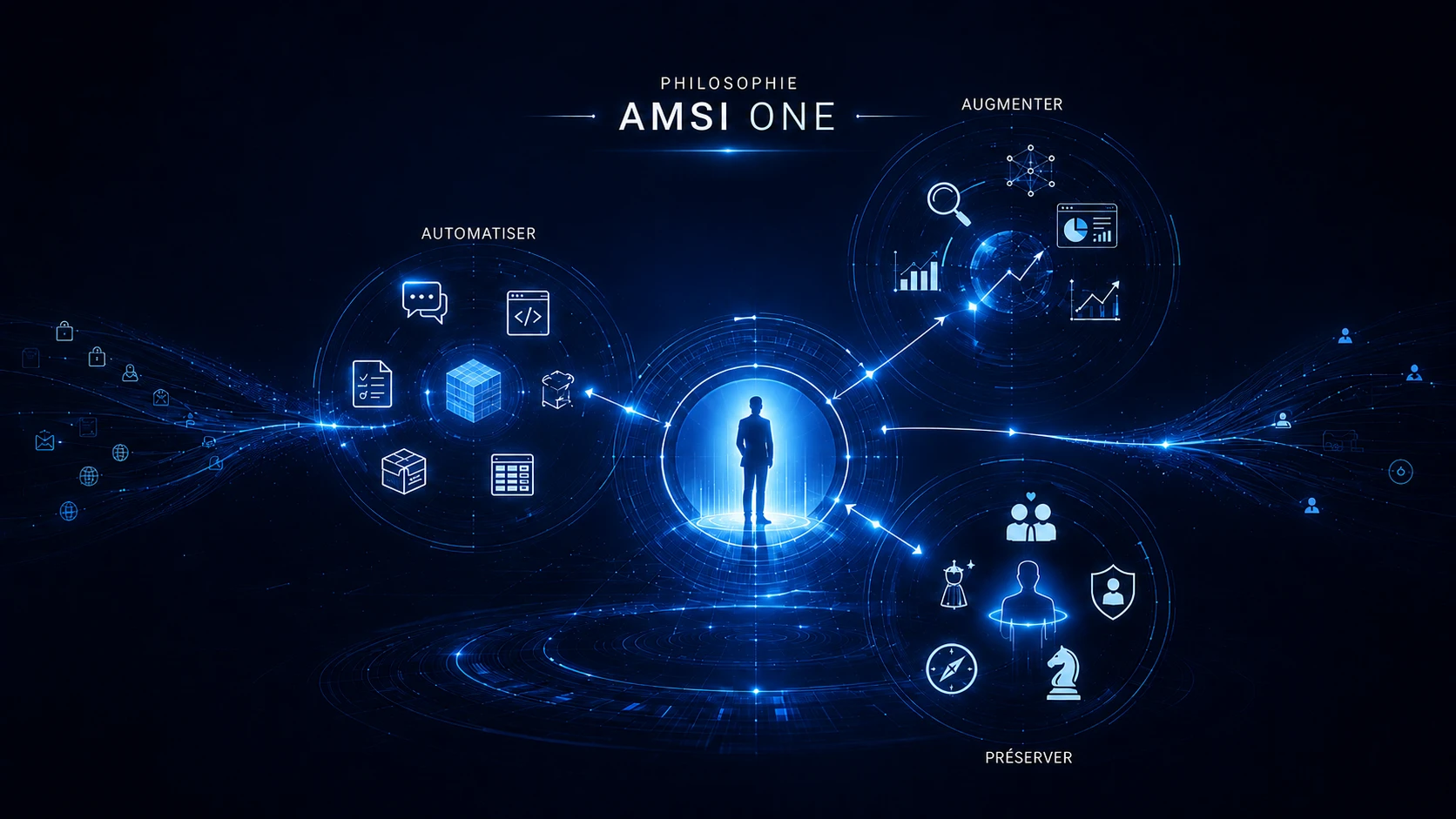
This is precisely the philosophy behind AMSI ONE.
The objective is not to build a business in which artificial intelligence progressively replaces professional expertise. It is to determine, for each function, what deserves to be automated, what should be augmented by technology and what must remain under human responsibility.
Automate what is known
When tasks are repetitive, documented, structured, measurable and controllable, AI can deliver considerable gains in speed and productivity.
It reduces the time spent searching, classifying, comparing, reformulating or presenting information that is already available.
Augment what needs to be better understood
Artificial intelligence becomes even more valuable when it enables experts to connect more data, identify weak signals earlier, compare performance or explore hypotheses they would not have had time to investigate manually.
Conversion, customer knowledge, merchandising, search visibility, content or growth: AI can give professionals greater observational and analytical capabilities.
Preserve what involves responsibility
Brand intention, sensitive customer relationships, commercial exceptions, strategic judgement, founding creativity and responsibility for a decision should not be surrendered simply because a system is capable of producing a convincing recommendation.
AMSI ONE is not designed to replace professional expertise. It is designed to enable professionals to see more, understand faster and act with greater precision.
Automate. Augment. Preserve. A framework for deciding where AI belongs
A company’s maturity in relation to artificial intelligence should therefore not be measured by the number of tools deployed or the percentage of tasks automated.
It should be measured by the precision with which the organisation can answer three questions.
Automate
Is the rule sufficiently well known, documented and controllable for the action to be automated without losing value or control?
Augment
Can artificial intelligence enable an employee or expert to see more, understand a situation more clearly or make a decision more quickly?
Preserve
Does the situation involve an intention, a relationship, an exception, a creation, a judgement or a responsibility that still requires human oversight?
Automate. Augment. Preserve.
This hierarchy allows us to move beyond the sterile debate between technological fascination and systematic defence of human involvement. It brings the question back to where it belongs: value creation.
Artificial intelligence increases power. Humans continue to provide direction.
The most successful businesses will probably be neither those that have tried to automate everything nor those that have attempted to preserve every human task artificially.
They will be those that have learnt to distinguish precisely what should be entrusted to technology, what benefits from being augmented by it and what cannot be surrendered without losing part of the business’s own intelligence.
AI can process what we know, help us discover what we struggle to see and accelerate what takes us too much time.
But when a situation has only just changed, when an intention needs to emerge, when a relationship requires an exception or when a business must decide what it wants to become, humans do not simply remain in the loop.
They continue to help create it.
This reflection extends a conviction explored in our previous article: humans should not merely remain within the artificial intelligence decision-making loop — they should help design it.
Does your organisation know what it should automate, augment and preserve?
AMSI CONSEILS helps business leaders identify the uses of artificial intelligence capable of delivering genuinely measurable value: automating what can be automated, augmenting the capabilities of teams and preserving the decisions, relationships and expertise that still require human judgement, discernment and responsibility.
The question is no longer how far artificial intelligence can go. It is about determining precisely where your business wants to hand over control to AI — and where it must continue to retain it.