

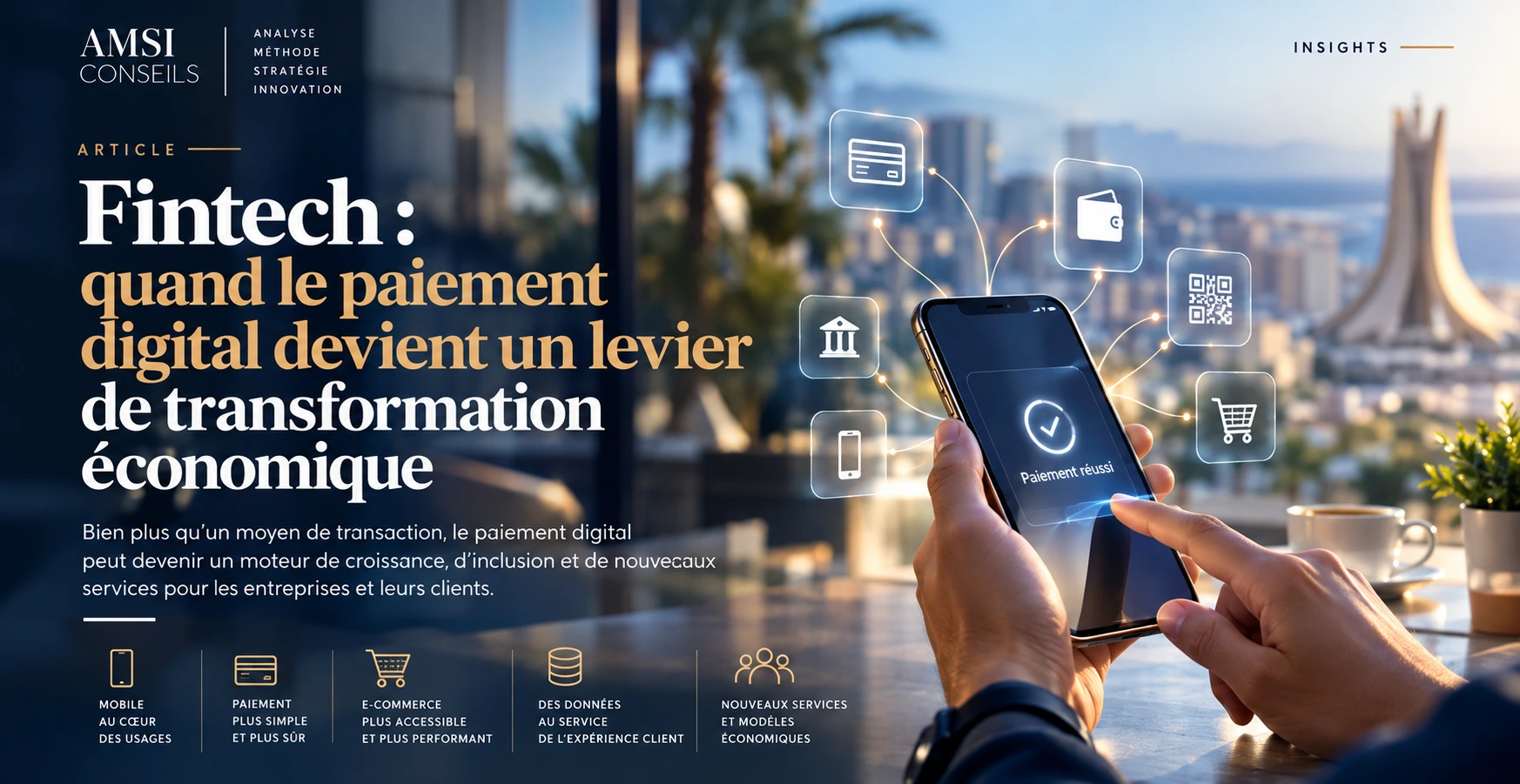
In some rapidly digitising economies, a paradox is emerging: cash continues to play an important role, while mobile technology, e-commerce and new digital behaviours are advancing rapidly. In these markets, the development of electronic payments could represent far more than simply an evolution in payment methods. It could transform customer relationships, foster new services and bring together worlds that have traditionally remained separate: banking, telecommunications, commerce and digital platforms.
What if the real fintech revolution were not the payment itself, but everything that can be built around it?
Digital payments are no longer simply about paying
For a long time, payment was essentially the final stage of a transaction. A customer discovered a product, made a decision, purchased it, paid for it: the transaction was complete.
Digital technology is gradually changing this logic.
Payment can now form part of a much longer relationship:
Discovery → Purchase → Payment → Data → Relationship → Loyalty → New services
It is therefore becoming a strategic touchpoint between a business and its customer. Simplicity influences conversion. Security helps build trust. Integration into the digital journey can support loyalty and extend the customer relationship well beyond the transaction itself.
As payment becomes digital, it gradually ceases to be merely a financial function and becomes part of the customer experience.
Some markets now have a particularly distinctive set of conditions
Not all economies follow the same digital trajectory or adopt payment methods at the same pace.
In some markets, several trends coexist: cash remains deeply embedded, while smartphones are becoming central to everyday life. E-commerce is expanding, new digital services are emerging and initiatives designed to further dematerialise transactions are multiplying.
This coexistence may appear paradoxical. Yet it could create particularly favourable conditions for innovation.
Could an apparent lag sometimes become an opportunity?
Markets undergoing digital transformation today do not necessarily have to reproduce every stage that more mature economies have gone through over the past twenty years.
In some cases, they can move directly towards more recent technologies and behaviours.
Cash → Mobile → Wallet → Digital services
This acceleration, however, is never automatic. The availability of a technology does not mean that consumers or merchants will immediately adopt it. The real challenge therefore begins elsewhere: with usage.
From cash to mobile: the real battle will be over adoption
It would be tempting to assume that launching an app, a wallet or a new payment solution is enough to transform behaviour.
The reality is more complex.
To change an everyday habit as deeply ingrained as payment, technology must deliver an immediately recognisable benefit.
The new journey must be simpler, faster, more accessible, sufficiently secure and, above all, useful enough to justify a change in behaviour.
Consumers do not change their habits simply because an innovation exists. They do so when it solves a problem or genuinely improves their daily lives.
Financial transformation cannot be imposed through technology. It is won through adoption.
Trust therefore becomes just as important as infrastructure. A technically effective solution that is perceived as complex, untrustworthy or difficult to use may remain marginal.
Banks, fintechs, commerce and telecoms: the boundaries are beginning to shift
For a long time, the roles appeared clearly defined.
Banks managed financial services. Telecom operators provided connectivity. Merchants sold their products. Technology companies supplied the infrastructure.
Digital technology is gradually making these boundaries more porous.
Payments are one of the areas where this convergence is becoming particularly visible. A transaction can now begin on a smartphone, continue on a commerce platform, use a digital financial service and immediately generate new data that can enrich the customer relationship.
Why are telecom operators in a particularly interesting position?
In some markets, telecom operators possess significant advantages: a large customer base, a daily relationship through mobile services, technological infrastructure, a physical distribution network and an in-depth understanding of digital behaviours.
This does not mean that they will necessarily become dominant financial players. Regulatory constraints, trust, financial expertise and the ability to build effective partnerships remain decisive.
But a strategic question emerges:
Should a telecom operator remain merely a connectivity provider tomorrow, or could it become a gateway to an ecosystem of digital services?
Payments can become an accelerator for e-commerce
This transformation directly affects online commerce.
A business can invest in customer acquisition, improve its merchandising, optimise its product pages and refine its mobile experience: if payment introduces significant friction at the end of the journey, some of those efforts may be wasted.
On mobile, this requirement becomes even more important.
Every additional step, every moment of hesitation and every break in the journey can move the customer further away from conversion.
Basket → Identification → Delivery → Payment → Confirmation
Payment must therefore be regarded as an integral part of both user experience and commercial performance.
The performance of a payment solution should not be measured solely by the number of transactions it processes, but also by the number of friction points it removes.
Behind every payment lies another source of value: data
The digitisation of payments also generates a strategic resource: data.
A transaction can help businesses better understand purchase frequency, repeat behaviour, transaction values, patterns of consumption and certain customer behaviours.
When connected with other information from CRM, e-commerce or customer relationship systems, this data can help a business understand its customers more effectively and adapt certain services.
But one distinction is essential.
Accumulating data does not mean creating knowledge.
And having access to data obviously does not mean that every possible use of it is appropriate or permitted.
From transactions to customer knowledge
Value emerges when reliable, properly governed data, used in accordance with applicable rules, helps improve segmentation, a service, an experience or a decision.
Data creates value only when it helps improve a decision, a service or an experience.
The real transformation begins when payment opens the door to an ecosystem
This may be where the transformation becomes most interesting.
As digital payments develop, their value no longer necessarily lies solely in the transaction itself.
Payment can become the starting point for a much broader relationship:
Payment → Wallet → Loyalty → Services → Commerce → Data → Personalisation
A payment method can therefore gradually become a gateway to a wider range of digital services.
Competition then changes in nature.
The question is no longer simply which company processes the transaction. It becomes a question of which player controls the interface, earns trust and builds the most valuable relationship with the customer.
Value could gradually shift away from the transaction itself towards the ecosystem built around it.
But a fintech ecosystem cannot be built through technology alone
This prospect should not lead us to underestimate the obstacles.
The success of a new payment ecosystem depends on a combination of several factors:
Trust → Security → Simplicity → Interoperability → Accessibility → Regulation → User experience
A technically sophisticated wallet that is rarely used does not yet constitute a transformation.
A payment method available to consumers but difficult for merchants to accept does not yet constitute a genuine ecosystem.
Likewise, adding more features will never compensate for an overly complex experience.
The success of a fintech should not be measured solely by the sophistication of its technology, but by its ability to become part of everyday life.
What if payment were only the beginning?
Electronic payments may be only the first visible layer of a much deeper economic transformation.
They can gradually give rise to new services, new commercial experiences, new forms of loyalty and new business models.
Digital payment → New behaviours → Services → Digital commerce → Customer knowledge → Loyalty → New business models
In rapidly digitising markets, this convergence can create new strategic positions for banks, fintechs, merchants, technology platforms and telecom operators.
But no player automatically holds a lasting advantage.
Owning the technology does not necessarily mean owning the usage. Owning the usage does not necessarily mean earning trust. And having a large customer base does not guarantee the ability to build services that genuinely meet customer expectations.
It is probably at the intersection of these three dimensions — technology, adoption and trust — that part of the next transformation will take place.
The next battle may not be about payments
The first transformation is technological: making digital payments possible.
The second is behavioural: giving consumers and merchants sufficient reasons to adopt new ways of paying.
The third could be far more strategic: using these new behaviours to build services capable of improving the customer experience over the long term.
This is why fintech should probably no longer be viewed solely as an evolution of the financial sector.
It now sits at the intersection of commerce, technology, data, telecommunications and customer experience.
The real fintech revolution may not begin when we all pay with our phones. It will begin when payment becomes almost invisible and value shifts towards the services built around it.
And tomorrow, who will truly own the customer relationship?
The company that provides the product, the one that provides the network, the one that processes the payment… or the one that knows how to connect all three?